Tuesday, September 6, 2011

The Brothers Karamazov by Fyodor Dostoevsky


Yul Brynner was totally in a movie version of this, and that is awesome. That is all you need to know.

Oh, also, we're reading the above translation. I think. When I am more in a single location and in less chaos I will do better version of this post. Feel free to preemptively rectify in comments anyway.

Wednesday, July 27, 2011

Ficciones by Jorge Luis Borges


So, next up is Ficciones by Jorge Luis Borges. I believe most of us are reading the Andrew Hurley translation/anthology of other works too rather than the Boucher (pictured above, cooler cover) version.

Apparently there is some controversy  about translation, but my cursory side-by-side read through of the first few pages of several translations in the bookstore led to me choosing Hurley anyway--I thought he generally sounded better at least as far as the English went in the stories I sampled and you got more story-related bang for your buck with his edition, which I'm sure is very crass of me. I asked Alex Foreman whose translation was best, and he said his was, but he's not done with it, so so much for that :p . He has translated some of Borges' poems though, if you're interested, on his blog.

As per usual, comments/notes will be posted and whatnot if you like.

Friday, July 15, 2011

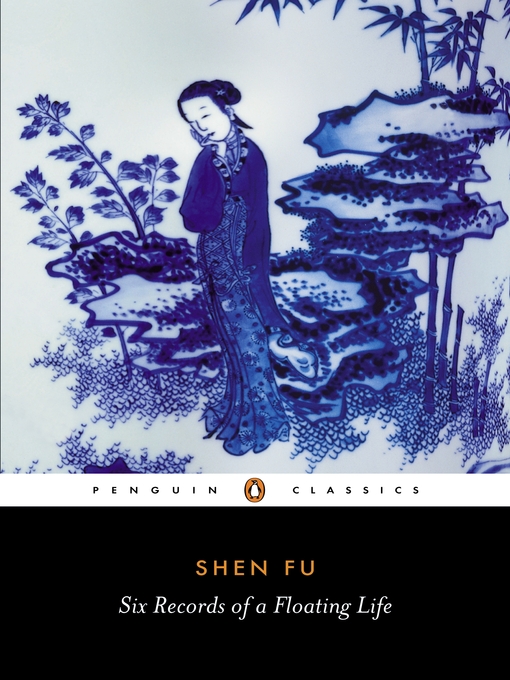
Six Records of a Floating Life by Shen Fu


Belatedly, we are reading Six Records of a Floating Life (in this edition) by Shen Fu, with the discussion scheduled for Wednesday, the 20th of July at 3: 00 pm central/4:00 pm eastern. All very official :p

The wikipedia page is stunningly useless (Shen Fu's page is marginally more informative, and is a decent gateway to cultural/period context if you link-hop), so the usual default for background information is a no go.

This is an intensely annotated index by a guy in East Asian Studies at Cambridge. A little in-depth to get through all of when you don't speak Chinese, but if you had any places where you were curious about phrasing/translation I'm sure he addresses it somewhere.


Feel free to comment with your thoughts or send them to me to post!

Friday, July 1, 2011

The First Round of Books

The Tearoom bookgroup is now in session *bangs gavel*. The members and the current books up for a vote are as follows:

Plato: [Has read none of them entirely]

The Laws by Plato
  • I read the first half of it two summers ago in between logic problem sets. Most of you have read the Republic which makes this a great choice because we get to see his recommendation for a real city-state as opposed to the Republic which is clearly an idealization. Also we know for sure, from the testimony of Aristotle, that this was the last work Plato wrote before he died. This gives it something of an authoritative place within the cannon. Also he has clearly succumbed to a sort of senile, right-wing lunacy (more than usual), which is delightful.
Talking to Strangers by Danielle Allen
  • If I had been a good person I would have read the whole thing for my Aristotle project last summer. Instead I just ending up reading a key chapter or two. Danielle Allen is a classicist, but she uses this book as a forum to pose as a philosopher/political theorist/cultural commentator. The result is an impressive investigation of the citizenship and democracy viewed in light of the 50th anniversary of Brown v Board of Education. Its sort of an interdisciplinary whirlwind of pretty interesting thoughts about race relations and liberal democracy. It is very accessible to a non-specialist audience. A big part of her argument (from what I have read) is that democracies should not be used to simply create an open space for each and every individual to pursue his or her own life projects. Democracies need citizens which view the good of others as an essential part of their own flourishing and therefore pursue the common good (hence an impetus for some reflections on race relations). Thus, she is mounting a significant challenge to contemporary understandings of what is so great about liberal democracy while at the same time portraying the civil-right struggle as an ongoing process of reforming democracy. I have some mixed feeling about the book as a whole, but I think we would get a lot out of discussing it.
Brothers Karamazov by Dostoyevsky
  • Just about every other person with a college degree thinks it's the cat’s meow. I’ve never read it. My mother has been badgering me to. On the downside it is an enormous book.
After Virtue by Alasdair MacIntyre
  • This I the one I have the most reservations about recommending to this group. This book was one of the most influential work in the later twentieth century arguing that we need to ditch modern ethical theories and go back to Aristotle. It remains extremely contentious to this day. Its not pitched to a non-specialist audience, but you are all smart people, you’d get the point. I’ve never read it before, and I will basically have to in order to succeed in grad school, so if anyone wants to read it with me, you are welcome to come along for the ride.
Seige: [Has read all of them except Ficciones]
Foucault's Pendulum or Name of the Rose by Umberto Eco  
  • [F] Three Italian editors decide as a joke to make up a conspiracy theory that explains everything. Then they are hunted down by the people in their conspiracy who are cheesed that the editors know more about what's going on than they do. Exhaustively researched, very richly written.
  • [N]  Detective-Monk in medieval monastery murder mystery! Ditto with the research. Neither of these are light reading, despite alliteration. Lot of history.
Fear and Trembling by Kierkegaard  
  •  Seminal work of (christian) existential thought, taking as its starting point the story of Abraham and Isaac, and how fundamentally what-the-fuck that story is. Also this.
The Myth of Sisyphus by Camus  
  •  Seminal work of (not christian) existential thought, taking as its starting point the question of suicide and concluding with the notion that Sisyphus wins!
Ficciones by Borges
  • Borges is cool and I need to read more of him. This book contains the story "Tlön, Uqbar, Orbis Tertius" which seems like the most fascinating story I have not yet read.
Sid: [Has read none of them (but stuff by the same author she really liked) except Floating Life several years ago]
Six Records of A Floating Life by Shen Fu
  • A fairly short book, written in the early 1800s by a poor Chinese civil servant, so not the kind of person from that place/time whose thoughts are usually preserved. I read it my first year, and I remember it as a strange, sweet, poetic sort of recording of his life, focused mostly on his relationship to his wife and some friends, with digressions into flower arranging. The back describes it as showing 'layers' of a person's life, which from what I remember is a pretty apt description.
The Comedians by Graham Green
  • The sum total of what I know about this book is that there are three main characters at least, and it's set in Haiti as it descends into chaos. However, I've read a lot of Graham Green in the past and always loved his work (my favorite book of his would probably be The Ministry of Fear, which I would also be up for reading, but have already read). He has a really distinct style; cold war-ish realism on the surface but with a constant sense of something surreal or fable-like around it.
Billiards at Half-Past Nine by Heinrich Boll
  • I know very little about this book; having read the first ten pages or so only I can tell you that it's about an architect who has probably done something truly terrible at one point and is now living a very quiet life. I put in on the list because I've wanted to read something by Boll forever and this is the book that I own at the moment. I'd also be pretty excited to read The Clown, although it seems like it might be one of the more depressing books I've ever laid a hand on. Boll is a pretty dark writer, from a family of pacifist Germans who grew up during WWII, so bad times. Apparently he won the Nobel Prize for Literature?
Waiting For The Barbarians by J. M. Coetzee
  • Another Nobel Prize guy, I think most of you have heard of him. I haven't read more than the first chapter, but it's another strange fable-story about a provincial governor attached to a great Empire whose peaceful life is interrupted by a state of emergency/war being declared against the barbarians. 
The Blind Assassin by Margaret Atwood
  • More tentative about including it, but I just started it anyway and I've been enjoying it so far. Longer than the others, it opened in a way I really enjoyed, weaving pieces of an affair in the modern era with newspaper clippings and a story set in a bizarre alternate space world. However, it just randomly switched into 1st person someone else's POV, which is also good but somewhat bewildering and I kind of want the first part back. I'm not sure what it's doing yet, but it seems intriguing and Atwood has been pretty good in the past.
    Squiddy:

    Death is a Lonely Business by Ray Bradbury

    Hard-boiled Wonderland and The End of The World by Haruki Murakami

    The Difference Engine or Pattern Recognition by William Gibson
    • The benefit of The Difference Engine is that it's not part of a series (Pattern Recognition stands alone fine, but is technically the first in a trilogy). The Difference Engine was written with Bruce Sterling. Sterling and Gibson are two of the four big founders of cyberpunk.
    MathGoat:

    Dead Souls by Gogol
    • Never read it before, but I've heard excellent things about it. I've read a little Gogol previously (short stories, e.g. "The Nose"), and remember liking it immensely.
    Pale Fire by Nabokov
    • This book consists of a 999-line poem by a fictional author, and a commentary on said poem by a fictional critic. Again in the category of "Never read, heard great things." Those I've talked to compare it favorably to similar stories by Borges, especially "Pierre Menard, Author of Don Quixote" and "Approach to Al-Mutasim" (both of which appear in "Ficciones," incidentally).
    The Crying of Lot 49 by Pynchon
    • One of those great books I never got around to reading. I've never read anything by Pynchon, but I've heard great things about him and this book.
    Rock 'n' Roll by Stoppard
    • I have never read this play, but I've read several other plays by Stoppard, and two in particular - "Rosencrantz and Guildenstern are Dead" and "Travesties" - rank among the most excellent things of all time (granted, it's a long list). My parents have seen this play, and both gave it very good reviews. In brief, the play is about the history of Czechoslovakia and the role rock music played in it (pun intended). Granted, this would be very short - I imagine we would all finish it quite quickly - but I think it would be delightfully fun.
    Tractatus Logico-Philosophicus by Wittgenstein
    • I originally was going to avoid suggesting philosophy books, but Dan broke the ice with the Laws. I read the Tractatus, or most of it anyways, a long time ago when I was too young to understand it. Now, glancing at bits and pieces of it, I'm impressed by its beauty, even if I am not convinced by its arguments. I think we could have a very interesting time with it. (It is worth noting that Wittgenstein's notebooks are available as separate publications, and they might be interesting as secondary sources.)
    Tender is the Night by Fitzgerald
    • Fitzgerald's more famous book, "The Great
      Gatsby," is one of my absolute favorites of all time. The ending of Gatsby is for
      me one of the most moving moments in literature. Whenever I feel (more)
      dissatisfied (than usual) with humanity, I read that portion of the book.
      Fitzgerald's understanding of the beauty of failure is truly profound. I'm
      rambling, I realize, so long story short: Fitzgerald is awesome, and I have every
      reason to believe that "Tender is the Night" is worth reading. (Also: if you haven't
      read Gatsby, you should.)


    Semiel:


    Smokes: